📑 Visa & Law
Bringing Your Family to Japan — The Basics of the Dependent Visa
Living together with your spouse and children: who you can bring, when you can't, and whether they can work
📖 8 min read📅 2026-09-17
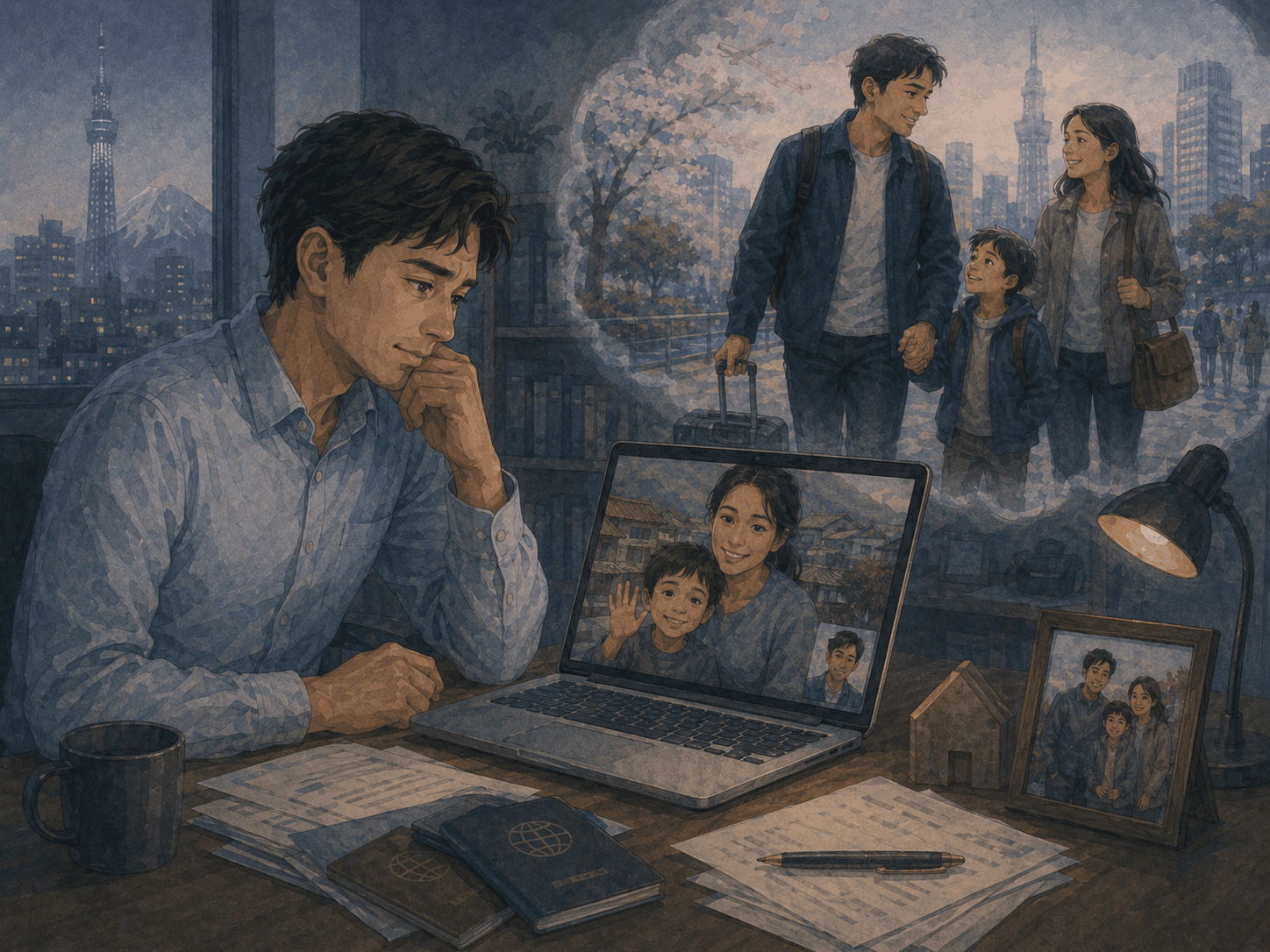
"Can I bring my wife and child to Japan?" — Living like a single person posted away from home, he had reached his limit.
Dipesh (32), from Biratnagar in Nepal, had worked in Japan as an IT engineer for three years. His residence status was "Engineer/Specialist in Humanities/International Services." His work was going well, but he could only see the wife and young son he had left in his home country once a year. Each time he watched his son grow up on the other side of a video call, his heart ached.
"I want to bring my family here. But can a foreigner really bring their family to Japan?" — Dipesh knew nothing about the system. The procedures seemed complicated, it would cost money, and he feared it might not even be approved. Those worries kept him from taking the first step.
One day he asked a senior colleague at work — another foreigner who had brought his own family over — and was told: "There's a visa called the 'Dependent' visa. With the Engineer/Specialist status, you can bring your wife and child. I brought my family last year, too."
Dipesh hadn't known: if you hold a certain residence status, there is a system that lets you bring your spouse and children to live with you in Japan.
The "Dependent" visa for bringing your family to Japan. Who can bring family, whether they can work, and how the procedure goes — we've gathered the most common questions in a Q&A format.
The "Dependent" status of residence is for foreigners working or studying in Japan to bring family from their home country to live together. However, it's not the case that "anyone can bring anyone." Let's go through the conditions one by one.
❓ Frequently Asked Questions
Q.Which family members can I bring on a Dependent visa?
A.You can bring your "spouse (husband or wife)" and your "children." Under the law, the Dependent status is limited to spouses and children, so you generally cannot bring your own parents or siblings. This is because the Dependent status is for family members who are financially supported by a foreigner active in Japan. As for children, there is no clear age written into the statute, but what matters is the actual reality of being "supported by you" (for adult children who have become independent, the reality of that support will be questioned).
Q.Can I bring family on my residence status?
A.It depends on your residence status. Statuses that allow you to bring family (that qualify for the Dependent status) include Engineer/Specialist in Humanities/International Services, Specified Skilled Worker Level 2, Business Manager, Highly Skilled Professional, Researcher, Instructor, Skilled Labor, Student, and others. On the other hand, take care: Specified Skilled Worker Level 1 and Technical Intern Training are NOT included among the statuses eligible for the Dependent status. In other words, people residing under Specified Skilled Worker Level 1 or Technical Intern Training generally cannot bring their family to Japan. With Specified Skilled Worker, once you move up to Level 2 you become able to bring them.
Q.Can the family I bring work in Japan?
A.Family members who come to Japan on a Dependent visa generally cannot work. However, if they obtain "permission to engage in activities outside their status," they can do part-time work and similar within 28 hours per week. They cannot work full-time (more than 28 hours per week). Working without obtaining permission counts as "illegal work," and not only the person but also the company that hired them can be penalized — so always obtain permission to engage in activities outside status first (the application is free, and the permission is noted on the back of the residence card and elsewhere).
Q.What matters most in the screening?
A.Two things: "whether you have sufficient income to support them" and "whether the family relationship is genuine." It will be examined whether you have stable income and assets enough to support your family (confirmed through a certificate of employment, or a resident tax certificate / tax payment certificate). It will also be confirmed, through family registers, marriage certificates, birth certificates and the like, whether the marriage or parent-child relationship has real substance. Properly paying your taxes and insurance premiums also contributes to a positive assessment of your stability.
Q.What is the procedure for bringing family who are overseas?
A.There are four main steps. ① You, here in Japan, apply to the Immigration Services Agency for a "Certificate of Eligibility (COE)." ② Once the COE is issued, you send it to your family in your home country. ③ Your family uses the COE to apply for a visa at the Japanese embassy or consulate in their home country. ④ Once the visa is issued, they travel to Japan and receive their residence card at the airport. You handle the immigration procedure in step ① here in Japan, and your family handles the visa application in step ③ in their home country. Screening usually takes one to three months.
Q.What documents do I need?
A.Mainly: ① the application form for a Certificate of Eligibility, ② photographs, ③ documents proving the family relationship (family register, marriage certificate, birth certificate, etc.; attach a Japanese translation for documents in a foreign language), ④ documents proving your income (certificate of employment, resident tax certificate / tax payment certificate), and ⑤ a copy of your residence card. Because the format of family-relationship certificates differs by country, arrange to obtain official versions in your home country in advance.
Q.Is the "Dependent" status different from "Spouse of a Japanese National"?
A.Yes, they are different. The "Dependent" status is for the family (spouse and children) of a foreigner residing for work or study, and it has work restrictions (up to 28 hours per week with permission to engage in activities outside status). On the other hand, "Spouse or Child of a Japanese National" and "Spouse or Child of a Permanent Resident" are residence statuses for the family of Japanese nationals or permanent residents, and they have no work restrictions (you can work full-time freely). It's a good idea to confirm the residence status that fits your situation with immigration or a specialist.
🤝 Where to get help (free, multilingual, anonymous OK)
Foreign Residents General Information Center (Immigration Services Agency)
You can consult in multiple languages about Dependent status, the COE, and permission to engage in activities outside status.
🌐 English, Chinese, Korean, Spanish, Portuguese, and other languages ⏰ Weekdays 8:30–17:15
📝 Contact via web →📞 0570-013904
