💗 Life & Wellbeing
Preparing for Earthquakes and Typhoons — So You Can Survive in Japan as a Foreigner
"The moment" comes suddenly. Preparations you can make today, and information sources you can rely on
📖 8 min read📅 2026-09-14
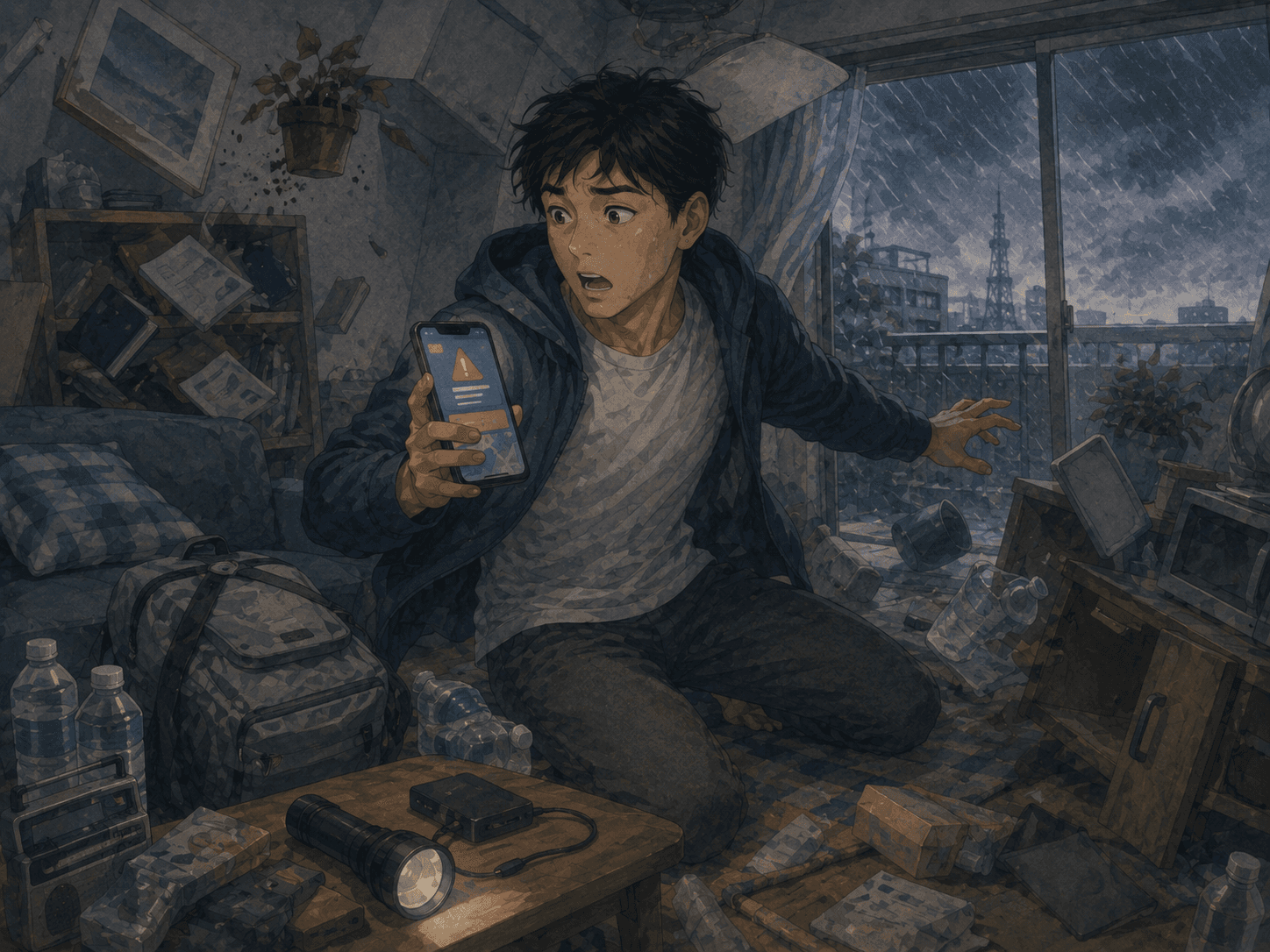
The night I first experienced a big earthquake, I had no idea what was happening or where to escape to.
The first time Phuong (27), from Haiphong, Vietnam, experienced a seismic intensity 5 earthquake in Japan was in the middle of the night, half a year after arriving. Suddenly, the room shook violently, things fell off the shelf, and an unfamiliar, loud alarm blared from her phone.
There were almost no earthquakes in her home country. Phuong couldn't understand what was happening and just clung to her futon. Even after the shaking stopped, "Will it come again?" "Should I escape outside?" "Is this building okay?" — knowing nothing, she was too scared to sleep a wink.
The next day, when she asked a coworker, she was told: "That sound was an Earthquake Early Warning. And Japan has disaster-prevention apps for foreigners and multilingual information. Let's set it up together."
Japan is a country with many earthquakes, typhoons, and heavy rains. But with the right knowledge and preparation, the fear is greatly reduced. And the disaster-prevention information for foreign nationals is far more substantial than you'd think.
So you don't panic when "the moment" comes, we've put together the preparations you can start today, in a checklist.
You can't prevent disasters, but you can prepare. Let's go through "advance preparation," "what to do when it shakes or a warning goes off," and "information sources you can rely on," in order. The fewer earthquakes there are in your home country, the more it's worth knowing.
01.Install a multilingual disaster-prevention app right now (Safety tips)
"Safety tips," supervised by the Japan Tourism Agency, is a free app that notifies your phone of Earthquake Early Warnings, tsunami warnings, weather warnings, and more, in multiple languages (English, Chinese, Korean, Vietnamese, etc.). Even if you don't understand Japanese, you can receive disaster information in real time. Disaster-prevention information from local governments and NHK WORLD, and the "NHK News & Disaster Prevention" app, are also useful. Rather than searching for it after an earthquake hits, install it today.
02.Know the sound of the "Earthquake Early Warning"
The distinctive alarm sound that suddenly blares from your phone (a "kyuin-kyuin" sound) is the "Earthquake Early Warning." It sounds a few seconds to a few dozen seconds before strong shaking arrives. When this sound goes off, immediately take action to "protect your head," "turn off any flames," and "open a door to secure an exit." It's startling the first time you hear it, but remember it as "a signal that gives you time to protect yourself."
03.When an earthquake comes, "protect yourself first." Don't rush outside
When you feel strong shaking, the basic move is to "hide under a sturdy desk and protect your head." Rushing outside risks injury from falling objects (signs, glass, roof tiles). After the shaking stops, check sources of fire, and open doors and windows to secure an escape route. Don't use the elevator — take the stairs. If you're cooking, turn off the gas after the shaking stops (many recent stoves shut off automatically).
04.Confirm the location of your "evacuation shelter" now
Look up now where the "evacuation shelter" (school, community center, etc.) is in the area where you live. You can check on your municipality's website, or on the "hazard map" (multilingual versions available) your local government hands out. The "Safety tips" app also has an evacuation-shelter map feature. Just knowing where to escape to in an emergency greatly changes how you act. Deciding on a meeting place with family and friends also brings peace of mind.
05.At least 3 days' worth of supplies (water, food, mobile battery)
In a disaster, electricity, water, and logistics can stop. Keep at least 3 days' (ideally a week's) worth of supplies: ① water (3 liters per person per day), ② food that keeps (cup noodles, canned goods, retort pouches, snacks), ③ a mobile battery (a lifeline for gathering information and staying in touch), ④ a flashlight, ⑤ regular medications and a copy of your residence card. A way to charge your phone in particular is essential for safety confirmation and gathering information.
06.For typhoons and heavy rain, "act early." Know the alert levels
Unlike earthquakes, typhoons and heavy rain are forecast in advance. Weather information announces "alert levels." At Level 3, the elderly and others begin evacuating; at Level 4, everyone evacuates; Level 5 means "a disaster has already occurred — take the best action to protect your life." Move to a safe place by Level 4. People who live near rivers or mountains, or on low ground, should be especially careful. The iron rule is to not think "I'm still fine" and to move early.
07.Decide in advance how to "confirm safety" with family and your company
In a disaster, phones become hard to connect. Remember: ① the "Disaster Emergency Message Dial (171)" and the "Disaster Emergency Message Board (web171)," ② messaging apps like LINE (which get through more easily than phone calls), and ③ posting that you're safe on social media. Telling your family back home in advance "if I'm safe, I'll contact you via ◯◯" reduces anxiety for both sides. It's also good to confirm with your company the contact method during a disaster and the criteria for deciding whether to come to work.
The very next day, Phuong installed Safety tips, confirmed her evacuation shelter, and bought water and a mobile battery. There were several more earthquakes after that, but just knowing "what to do" greatly reduced her fear, she said. "Not knowing was the scariest part. Once I prepared, I could act calmly," she told us. If you have concerns about disaster information or evacuation, you can consult the foreign-resident consultation desk of your municipality or the international exchange association.