📑 Visa & Law
What Is Specified Skilled Worker Level 1? — Sectors, Exams, and How It Differs from Technical Intern Training
The up-to-date 2026 guide, so outdated information online doesn't mislead you
📖 8 min read📅 2026-07-09
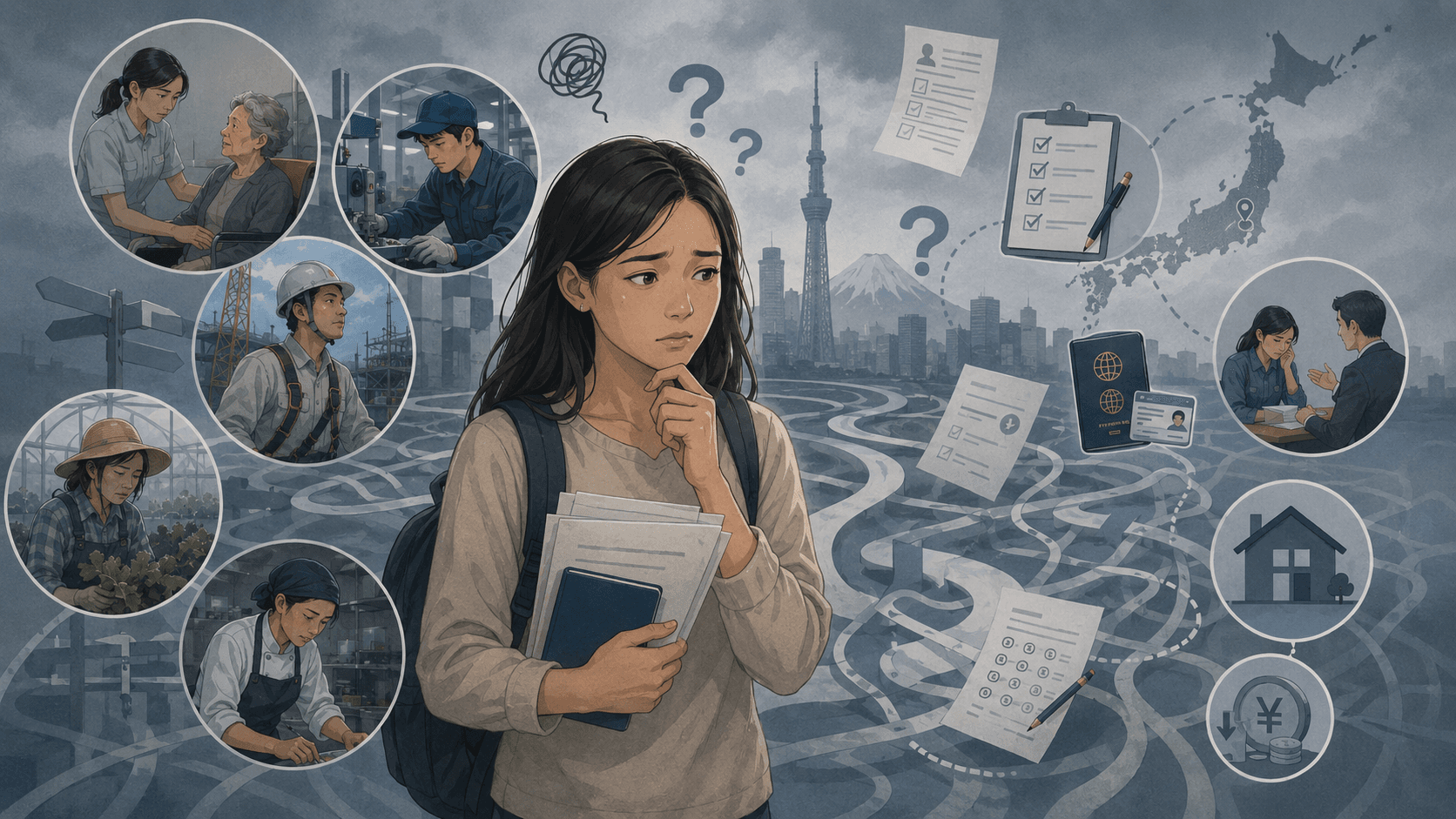
"So what exactly is Specified Skilled Worker? Every article I read says something different."
Maria (24) from Davao, Philippines wants to work in nursing care in Japan. In spring 2026, she started gathering information through social media and web searches.
One article says the program covers "14 sectors." Another says "16 sectors." A recent video claims "it has grown to 19 sectors." The exams were just as confusing: "You need JLPT N4." "No, a test called JFT-Basic is enough." "If you've completed technical intern training, no exam is needed." — She could no longer tell which was true.
When she asked a sending agency, all they said was, "Leave it to us and you'll be fine." But Maria had heard a story from a senior from her hometown: "I left everything to an agency without understanding the system, and ended up paying steep fees." If you don't understand the system yourself, you can't spot a bad broker either.
There is actually a reason Maria got confused. Specified Skilled Worker is a relatively new program that started in 2019, and its target sectors have been expanded again and again. The older the article, the older the numbers left sitting in it.
This article organizes the latest rules as of June 2026 in FAQ form, based on official information from the Immigration Services Agency. Whether you're hoping to work in Japan or are in technical intern training right now, start here.
Specified Skilled Worker is a residence status for foreign nationals who work as ready-to-perform talent in sectors facing labor shortages. There are Levels 1 and 2; this article focuses on Level 1, the entry point.
❓ Frequently Asked Questions
Q.What kind of residence status is Specified Skilled Worker Level 1?
A.It's a residence status (introduced in 2019) that lets you work as ready-to-perform talent with "a considerable degree of knowledge or experience" in designated industry sectors where Japan faces serious labor shortages. Unlike Technical Intern Training, it is a status whose purpose is "work" from the very start — and by law, your employment contract must pay you "equal to or more than a Japanese worker doing the same job." Overtime pay, social insurance, and paid leave also apply in full, under the same labor laws as for Japanese workers.
Q.Which sectors can I work in? Which is correct — "19 sectors" or "16 sectors"?
A.Both are correct — that's the answer. On paper, the program covers 19 sectors (three sectors — logistics warehousing, linen supply, and resource recycling — were added in January 2026). However, the skills exams for these three new sectors are still being prepared, so people are expected to actually start working in them around 2027. In other words, as of June 2026 you can actually work in 16 sectors: nursing care, building cleaning, industrial products manufacturing, construction, shipbuilding and ship machinery, automobile maintenance, aviation, accommodation, automobile transport, railway, agriculture, fishery, food and beverage manufacturing, food service, forestry, and timber industry. Note: among these, the food service sector is currently restricted. Because the sector is expected to reach its admission cap (50,000 people), new applications received on or after 13 April 2026 — certificate of eligibility applications from overseas, and change-of-status applications from other residence statuses — are not granted, or are in principle refused. Applications from people already residing in Japan under Specified Skilled Worker (i) in food service, such as when changing jobs, are not affected. No end date for this measure has been announced.
Q.What do I need to obtain Specified Skilled Worker Level 1?
A.There are two routes. [Route 1: Exams] Pass the skills evaluation exam for the sector you want to work in, plus a Japanese language test (JLPT N4 or higher, or JFT-Basic — the Japan Foundation Test for Basic Japanese). The nursing care sector additionally requires the Nursing Care Japanese Language Evaluation Test. Exams are held not only in Japan but also overseas — in the Philippines, Vietnam, Indonesia, Nepal, and other countries. [Route 2: From Technical Intern Training] Explained in the next question.
Q.Is it true that people who completed technical intern training can transition without exams?
A.True, with conditions. If you completed Technical Intern Training Level 2 "in good standing" (training as planned for 2 years and 10 months or more), the Japanese language test is waived regardless of sector. The skills exam is waived if you move into a sector related to the job category you trained in. If you move into an unrelated sector, you only need to pass that sector's skills exam. For the concrete application steps, required documents, and schedule, see our article "How to Switch from Technical Intern Training to Specified Skilled Worker."
A.Yes — and this is a major difference from Technical Intern Training. You can change companies within the same work category (to move to a different sector, you need to pass that sector's skills exam). One important caution, though: under Specified Skilled Worker, when your employer changes you must submit an application for permission to change your residence status to immigration, and you cannot start working at the new company until it is approved. The procedure can take 1–2 months, so before changing jobs, plan all the way down to living costs during the gap period.
Q.How many years can I work? Can I bring my family?
A.Specified Skilled Worker Level 1 has a cumulative limit of 5 years, and bringing family members is, as a rule, not permitted. But there is a path beyond it — pass the exam for advanced skills and transition to Specified Skilled Worker Level 2 (currently available in 11 sectors), and there is no limit on the number of residence period renewals, you can bring your spouse and children if you meet the requirements, and the road to applying for permanent residency opens. Nursing care is not covered by Level 2, but there is an alternative route: obtain the Certified Care Worker (kaigo fukushishi) qualification and switch to the "Nursing Care" residence status. This is not a status that simply ends after 5 years.
Q.I'm anxious about life in Japan. Is there support from the company?
A.Under Specified Skilled Worker Level 1, support from the accepting company (or a registered support organization the company outsources to) is required by law. It covers 10 items: ① pre-arrival guidance, ② airport pickup and drop-off, ③ help securing housing and signing life contracts, ④ life orientation, ⑤ accompaniment to government-office procedures, ⑥ opportunities to learn Japanese, ⑦ responses to consultations and complaints, ⑧ promoting interaction with Japanese people, ⑨ job change support if the company can no longer employ you for its own reasons, and ⑩ regular interviews. Charging these support costs to the foreign worker is not allowed. If there is "no support at all," that in itself is a sign of a rule violation.
🤝 Where to get help (free, multilingual, anonymous OK)
FRESC — Foreign Residents Support Center (Ministry of Justice)
Comprehensive consultation on the Specified Skilled Worker program, residence procedures, and workplace problems.
🌐 English, Chinese, Korean, Portuguese, and 10 other languages ⏰ Mon–Fri 9:00–17:00
📝 Contact via web →📞 0570-011000